

If you’ve been lifting consistently and your progress has plateaued, it may be time to introduce a higher-intensity technique. Rest-pause training is a scientifically supported method that helps you break through stagnation by maximizing muscle fiber recruitment within a condensed training window — and the gains it delivers are real.
What Is Rest-Pause Training?
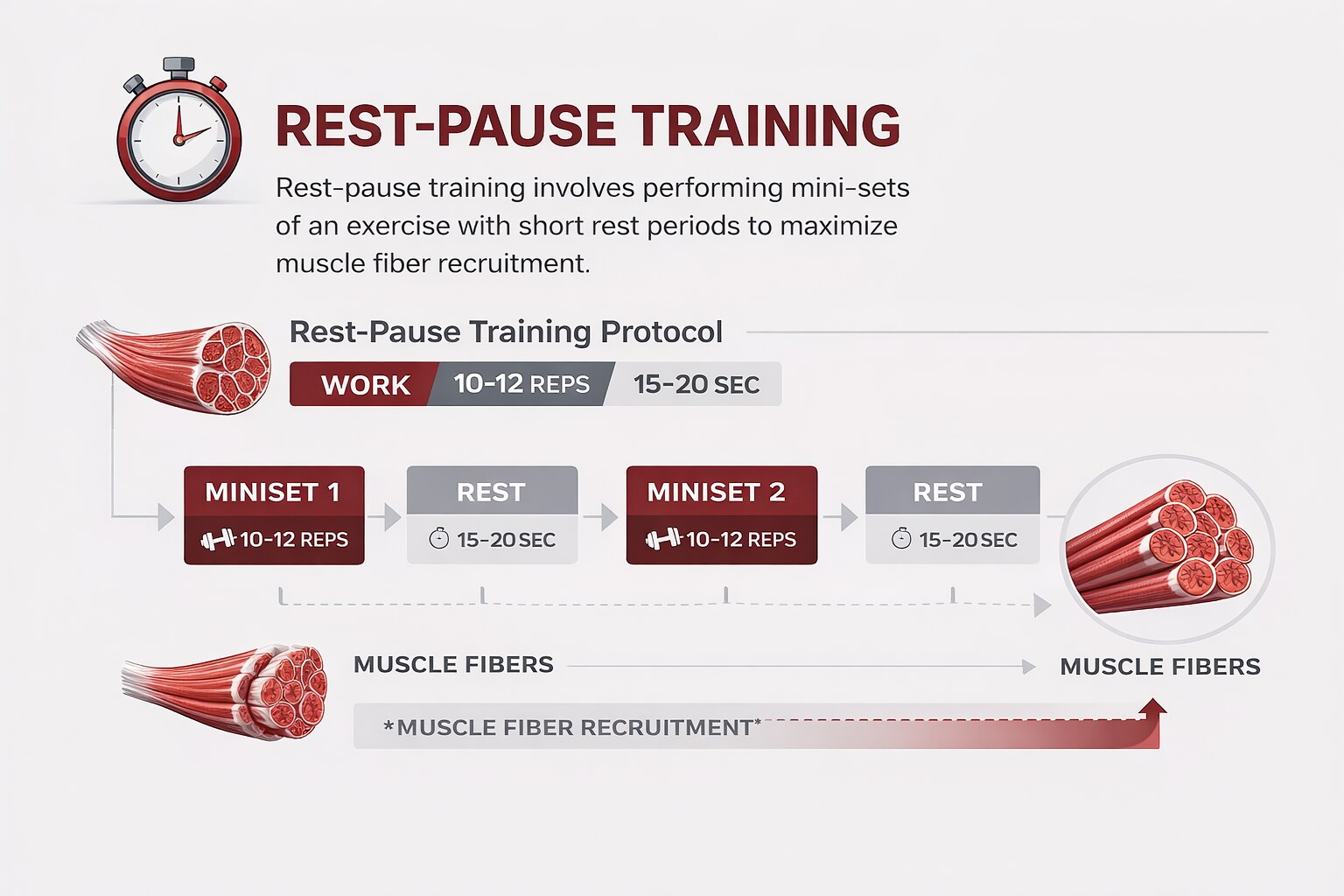
Rest-pause training breaks a single working set into multiple minisets using near-maximal loads, separated by brief recovery intervals. Instead of completing all your reps uninterrupted, you push to failure, rest 10–30 seconds, then repeat — until you’ve accumulated significantly more total volume than a conventional set would allow.
Research published in the Journal of Strength and Conditioning Research confirms that rest-pause protocols produce greater acute metabolic stress and muscle fiber activation compared to traditional straight sets, making them a powerful tool for both strength and hypertrophy goals.
Why It Works
When you train to muscular failure, you maximize motor unit recruitment and create substantial mechanical tension — two primary drivers of muscle growth. As those damaged fibers repair, they grow back thicker and stronger.
Rest-pause training achieves this repeatedly within a single session, essentially multiplying your time-under-tension without dramatically extending your workout duration.
Rest-Pause vs. Other Intensity Techniques
Rest-pause isn’t the only tool in the advanced lifter’s arsenal. Here’s how it compares:
- Supersets: Two exercises performed back-to-back with no rest (e.g., biceps curls → triceps extensions)
- Alternating Sets: Similar to supersets, but with a brief rest between exercises
- Drop Sets: Complete a set to failure, reduce load by ~20%, and repeat until minimal weight remains
Each has merit. Rotating between all of them across your training cycle prevents adaptation and keeps progress consistent.
Two Types: Strength vs. Hypertrophy
Your goal determines which rest-pause variation you use.
For Strength Gains
- Load: 80–90% of your 1-rep max (1RM)
- Protocol: Perform 1 rep → rest 10–15 seconds → repeat
- Target: Accumulate 10–12 total reps per set
For Muscle Hypertrophy
- Load: ~75% of your 1RM
- Protocol: Perform a miniset to failure → rest 20–30 seconds → repeat for 3 minisets
- Target: 6–10 total reps per miniset; complete 3 full sets with 90 seconds rest between

A 2021 review in Sports Medicine found that both high-load and moderate-load protocols, when taken to failure, produce comparable hypertrophy outcomes — making proper execution more important than load selection alone.
Common Mistakes to Avoid
Overloading too soon. If you’re new to 1RM-based training, ease in gradually. Chasing maximum weight before your technique is dialed in increases injury risk substantially.
Training rest-pause too frequently. This method is extremely demanding on your central nervous system and musculature. Use it on a biweekly rotation — apply it for 6–8 weeks, then cycle off for an equal period. Recovery is not optional; it’s where your gains are actually made.
How to Program It
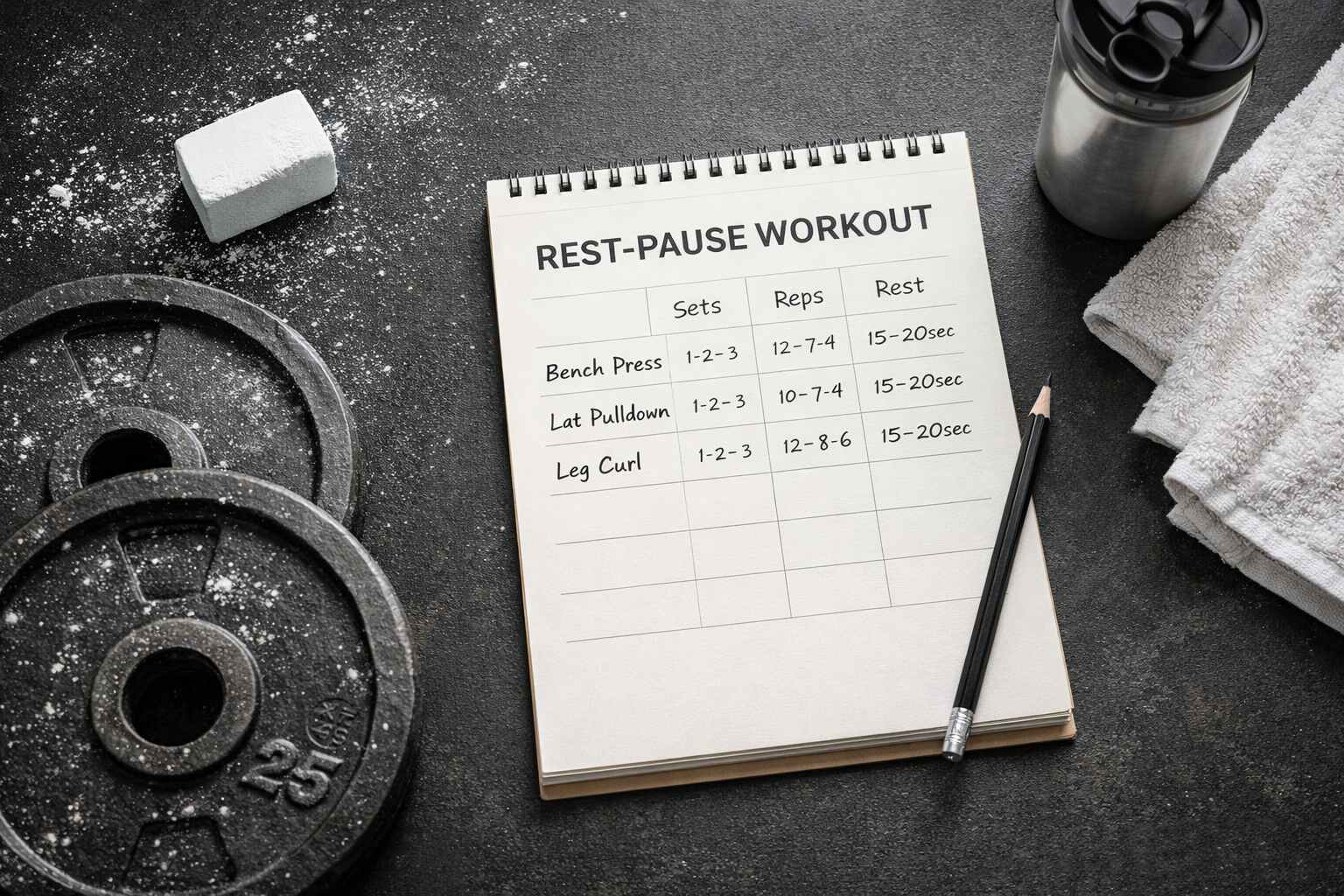
Introduce rest-pause on one or two compound movements per session — think squats, bench press, or barbell rows. Avoid applying it to every exercise; overuse defeats the recovery principle that makes it effective.
A practical starting point: replace your final working set of a major lift with a rest-pause set, once or twice per week.
The Bottom Line
Rest-pause training is one of the most efficient intensity techniques available to intermediate and advanced lifters. By pushing beyond what conventional sets allow, you accumulate greater volume, stimulate more muscle fiber, and accelerate both strength and size development — all within the same time investment.
Define your goal, select your protocol, and execute with discipline. The results will reflect the effort.
Sources:
- Prestes, J. et al. (2019). Journal of Strength and Conditioning Research — Comparison of rest-pause and traditional resistance training.
- Schoenfeld, B.J. (2010). Journal of Strength and Conditioning Research — Mechanisms of muscle hypertrophy.
- Grgic, J. et al. (2021). Sports Medicine — Effects of resistance training load on hypertrophy and strength.
Disclaimer: This article is for informational and educational purposes only. Consult a certified fitness professional or healthcare provider before beginning any new high-intensity training program, especially if you have a history of injury or musculoskeletal conditions.